


“I love when everything comes together” ¹
When it comes to these issues, “it never rains, it pours!”
“I love when everything comes together”¹
For construction projects, however, this situation is rather exceptional… According to McKinsey, 20% of projects are delayed and 90% suffer cost overruns ; on top of that, the larger and the more complex the projects, the worse the numbers get.
In the case of European transport infrastructure megaprojects the order of magnitude is, for 8 projects, 17.3 billion euros of cost overruns, i.e. a +47% increase compared to original estimates and an average delay of 11 years. And the situation is similar for industrial projects.
Since the execution of any project necessarily involves an element of uncertainty, after all “no battle plan survives the first contact with the enemy”, the challenge is to be able to quantify it at each stage of the project’s life cycle. It is this crucial task that time, pressure and some cognitive biases will disrupt, sometimes to the point of preventing you from having an accurate of the current situation and the milestones leading to your desired end state.
¹ Lieutenant-colonel John “Hannibal ” Smith in The A-Team
² Article “Imagining construction’s digital future” dated 24 January 2016
³ Article from La Croix dated 17 June 2020
⁴ Marshall Helmuth Karl Bernhard von Moltke
For construction projects, however, this situation is rather exceptional… According to Mc Kinsey², 20% of projects are delayed and 90% suffer cost overruns; on top of that, the larger and the more complex the projects, the worse the numbers get.
In the case of European transport infrastructure megaprojects³ the order of magnitude is 17.3 billion euros of cost overruns, i.e. a +47% increase compared to original estimates, for 8 projects and an average delay of 11 years. And the situation is similar for industrial projects.
Since the execution of any project necessarily involves an element of uncertainty, after all “no battle plan survives the first contact with the enemy”⁴ , the challenge is to be able to quantify it at each stage of the project’s life cycle. It is this crucial task that time, pressure and some cognitive biases will disrupt, sometimes to the point of preventing you from having an accurate of the current situation and the milestones leading to your desired end state.
¹ Lieutenant-colonel John “ Hannibal” Smith’s famous moto in The A-Team
² Article “Imagining construction’s digital future” dated 24 January 2016
³ Article from La Croix dated 17 June 2020
⁴ Marshall Helmuth Karl Bernhard von Moltke
When it comes to these issues, “it never rains, it pours!”
My expertise
Impact on your projects’ performance
Uncertainty not only has financial consequences…
Uncertainty not only has financial consequences…
As in the case of this oil construction company, which was seeing delays and cost overruns on its project increase without being able to estimate them or identify the precise causes, and was preparing to go to its customer to claim $500 million – the equivalent of twice the initial contract amount. An analysis of the project data revealed that the actual cost overrun was lower (c. $150 million) and that two-thirds of it was attributable to specific events for which their client was responsible. So, instead of spending several years in a lawsuit they would have lost, they negotiated a $100 million settlement with their client.

This is the case, for example, of this company, which has set up a large number of credit lines over the years to finance its production assets. When the time came to renew part of these assets, the treasurer realized he was unable to assess how much leeway he had to carry out the operation given the complexity of the financial criteria to be met due to the interactions of the different covenants. The operation was therefore frozen, putting at risk the ongoing business. At this stage it appeared necessary to review all the conditions that had to be met so that the company could negotiate with all its creditors a modus operandi allowing it to manage its cash flow while respecting its commitments and thus continue its business.
As in the case of this oil construction company, which was seeing delays and cost overruns on its project increase without being able to estimate them or identify the precise causes, and was preparing to go to its customer to claim $500 million – the equivalent of twice the initial contract amount. An analysis of the project data revealed that the actual cost overrun was lower (c. $150 million) and that two-thirds of it was attributable to specific events for which their client was responsible. So, instead of spending several years in a lawsuit they would have lost, they negotiated a $100 million settlement with their client.

… but also operational ones, sometimes to the point of jeopardizing the business.
… but also operational ones, sometimes to the point of jeopardizing the business.
This is the case, for example, of this company, which has set up a large number of credit lines over the years to finance its production assets. When the time came to renew part of these assets, the treasurer realized he was unable to assess how much leeway he had to carry out the operation given the complexity of the financial criteria to be met due to the interactions of the different covenants. The operation was therefore frozen, putting at risk the ongoing business. At this stage it appeared necessary to review all the conditions that had to be met so that the company could negotiate with all its creditors a modus operandi allowing it to manage its cash flow while respecting its commitments and thus continue its business.
Value Proposition
The size of the gap between a project’s planned and realized end-state is the major concern of strategic and operational teams throughout the project (and potentially even afterwards, if it needs to be explained and remedied).
“The proof of the pudding is in the eating”
Managing this gap requires having a precise view of both the current situation and future events at all times until the end of the project. The level of anxiety of the teams in charge is thus directly proportional to the level of uncertainty related to these two questions.
What if you could, at each phase of any given project, reduce these uncertainties? Wouldn’t that improve the quality of sleep of the strategic and operational management teams at the helm of your projects?
The size of the gap between a project’s planned and realized end-state is the major concern of strategic and operational teams throughout the project (and potentially even afterwards, if it needs to be explained and remedied).
“The proof of the pudding is in the eating”
Managing this gap requires having a precise view of both the current situation and future events at all times until the end of the project. The level of anxiety of the teams in charge is thus directly proportional to the level of uncertainty related to these two questions.
What if you could, at each phase of any given project, reduce these uncertainties? Wouldn’t that improve the quality of sleep of the strategic and operational management teams at the helm of your projects?
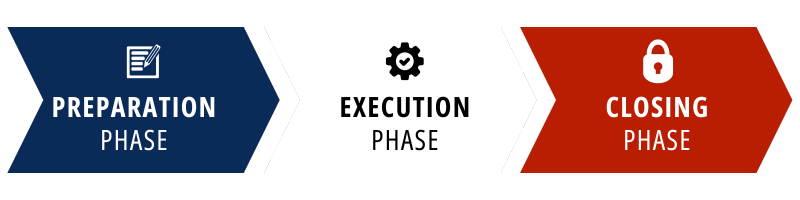
Definition: “How can one identify a doubt with certainty?”
Raymond DevosGroupthink and the sunflower effect are 2 powerful cognitive biases leading to pseudo-consensus and a scotomization of the reality of the situation. If you could in a few hours, with the help of a devil’s advocate, convince yourself of the robustness of the hypotheses considered, wouldn’t you feel more serene?
Execution: “By sacrificing the essential for the urgent, we end up forgetting the urgency of the essential”
Edgar MorinWhen teams are focused on the project delivery, they are likely to suffer from tunneling effect or recency effect, and temporarily oversee essential points. Would it not be helpful, in this context, to benefit from a holistic external view of the situation, to optimize your resource management?
Closing: “What the hell was he going to do in this mess?”
Scapin – Molière, Les Fourberies de Scapin (1671)Key moment when the initial plan and the actual situation can finally be compared; the discrepancies are then observed and must be accounted for and remedied as best as possible. Would you not then appreciate to benefit from “forensic” analysis capabilities using the stages of the intelligence cycle (definition of the need, collection of information, processing, analysis and synthesis) and quantify your room for manoeuvre in order to reduce your level of uncertainty?
Crisis & Conflicts: “Blood, toil, tears and sweat”
Winston ChurchillIt’s when pressure and stakes are at their highest that relations between stakeholders deteriorate most rapidly. In such situations, wouldn’t it be easier for your teams to apply the right negotiation and crisis management tools and guidelines?
They trusted me


They trusted me


Areas & examples of interventions

Description:
Key highlights:
4-week on-site mission in close collaboration with the customer’s accounting and operational teams during which the production process was entirely reviewed.

Description:
Key highlights:

Description:
Key highlights:

Description:
Key highlights:
Who am I?

Distribution of missions by industrial sector:

Nathan MORALI
Engineer by training, I started in the industrial sector in 2009 as an estimator and then moved to the consulting industry in 2011 where I carried out all types of missions in construction and industry.
I started by working with my teams on industrial site evaluation issues, before moving on to litigation management and then strategic issues around complex industrial projects.
Over the last 15 years I have had the opportunity to work in many types of industry and at all stages of project progress.
After 15 years of activity and a child, I created my own structure in order to focus on my core business: helping you carry out your complex projects.
Nathan MORALI
Engineer by training, I started in the industrial sector in 2009 as an estimator and then moved to the consulting industry in 2011 where I carried out all types of missions in construction and industry.
I started by working with my teams on industrial site evaluation issues, before moving on to disputes and then strategic issues around complex industrial projects.
Over the last 15 years I have had the opportunity to work in many types of industry and at all stages of project progress.

After 15 years of activity and a child, I created my own structure in order to focus on my core business: helping you carry out your complex projects.
If you want to know more
Education & Certifications

Ecole National des Ponts et Chaussées (ENPC)
– Engineering degree in mechanical and materials engineering
– MBA in international business

Conservatoire National des Arts et Métiers (CNAM)

ADN Group
Professional qualification from the PACIFICAT negotiation framework
